MindSave Official Website Label Desk Alpha GPC Has Two Research Records, And This Label Shows One
Alpha GPC Has Two Research Records, And This Label Shows One
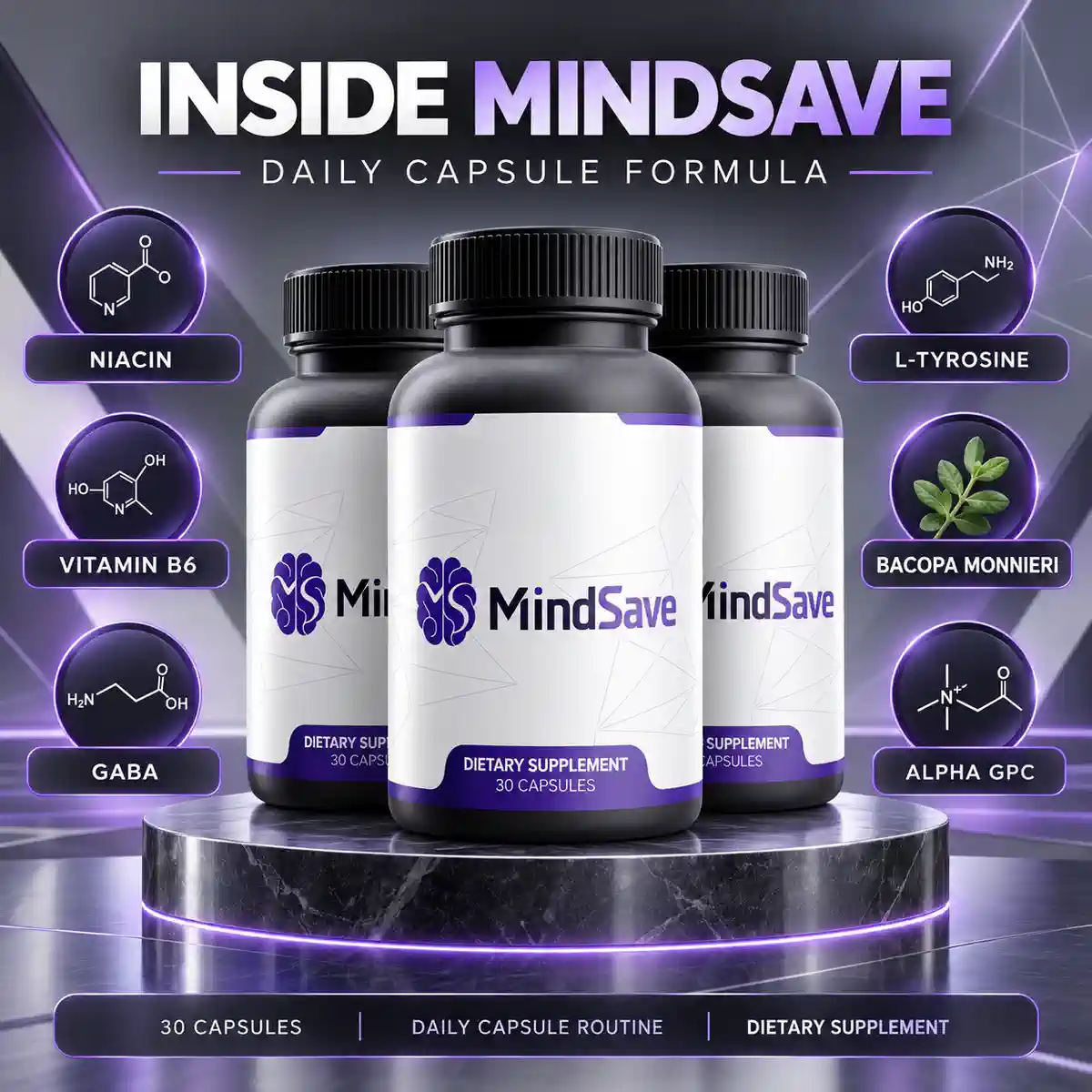
Alpha GPC is not one research record wearing one name. It is two records that happen to share a molecule: a small stack of sports-supplement trials in healthy adults, and a much larger clinical literature in patients with diagnosed cognitive impairment. The eight-name label on this website does not say which one, if either, applies to the capsule inside.
- Two names, one molecule. Alpha GPC and choline alfoscerate are the same compound. One name shows up on sports-nutrition labels, the other on a European prescription drug approved in 1985.
- Different doses. Sports trials used 250 to 630 mg, once or for a matter of days. The clinical literature dosed 1,200 mg a day, every day, for months.
- Different people. The clinical record is built on patients with a diagnosed cognitive or vascular condition, often taking a prescription cholinesterase inhibitor at the same time. It is not a record built on healthy adults having an ordinary week.
- MindSave discloses neither number. The sales page names alpha GPC and prints no amount, so a buyer cannot place this capsule on either scale.
One molecule, two names
Alpha glycerylphosphorylcholine is the sports-nutrition name. Choline alfoscerate, sometimes written choline alphoscerate, is the pharmaceutical name for the identical molecule. Manufacturers did not invent two compounds; two industries adopted the same one under two different labels, sold into two different markets, studied by two mostly separate groups of researchers who rarely cite each other's work in the same paper.
That split matters here because MindSave's sales page lists “Alpha GPC” among its eight names with no amount beside it, the same way it lists the other seven. The ingredients page already notes that a milligram figure, when one appears anywhere on this website, belongs to the study that produced it and never travels to this capsule. This page takes that warning further: which study, and which literature, is itself a live question for alpha GPC in a way it is not for most of the other seven names.
The record already on this website
The sports-nutrition side of alpha GPC's record is already set out on the eight-names page and the side effects page, so it is summarised rather than repeated here. Forty-eight healthy college-aged men took 250 or 500 mg a day for seven days and showed no difference from placebo on isometric strength or psychomotor vigilance. A separate crossover trial gave twenty trained men a single dose of 315 or 630 mg and found one attention test improved while two others and physical performance did not; its author discloses a paid advisory relationship with the study's sponsor. Two large South Korean cohorts also disagree about a stroke-risk association in people prescribed alpha GPC as a medicine, with Europe's food safety authority assessing roughly 204 mg a day as a supplement dose and finding no safety concern under the conditions it reviewed.
That is the literature most cognition-supplement marketing draws on when it mentions alpha GPC: small, short, in healthy adults, testing strength, attention or vigilance rather than everyday memory. It is a real record. It is also not the only one, and it is nowhere near the largest.
The record that is not
Choline alfoscerate received its first marketing authorisation as a medicine in 1985 and has been sold and studied under that pharmaceutical identity, mostly in Italy and other parts of Europe, ever since. A 2023 systematic review and meta-analysis searched PubMed, Web of Science and Embase, screened 1,326 studies down to 300 full-text articles, and settled on seven randomised controlled trials and one prospective cohort study that met its eligibility criteria. Every one of them studied patients with an adult-onset neurological condition, most involving cerebrovascular injury, rather than healthy adults looking for sharper everyday focus.
The pooled results are the part a sports-nutrition trial of this size could never produce. Alpha GPC combined with donepezil, the prescription Alzheimer's drug, improved cognition across four trials by a mean difference of 1.72 points on a 95% confidence interval of 0.20 to 3.25, improved functional outcomes across three trials by 0.79 (0.34 to 1.23), and improved behavioural outcomes across four trials by −7.61 (−10.31 to −4.91, lower being better on that scale). Patients who received alpha GPC alone also scored better on cognition than those who received either placebo or another medication, a mean difference of 3.50 points (0.36 to 6.63). The review's own conclusion: alpha GPC alone or combined with donepezil improved cognition, behaviour and function in patients with neurological conditions tied to cerebrovascular injury.
What the meta-analysis actually found, and who it studied
Read the population in that meta-analysis closely, because it is doing a lot of the work. These are not people managing an ordinary busy week. They are patients diagnosed with an adult-onset cognitive or vascular condition severe enough to be enrolled in a clinical trial, and in the strongest results, they were taking alpha GPC alongside donepezil, a cholinesterase inhibitor prescribed for diagnosed dementia. A combination effect measured in that population is not evidence about what the ingredient does on its own in someone without a diagnosis, and the review does not claim otherwise.
It is also a small literature by clinical-trial standards, seven RCTs and one cohort study, with the review's authors themselves noting ongoing disagreement between countries about whether choline alfoscerate should be an approved prescription medicine at all. Discrepant regulatory status across borders for the same molecule is itself a signal that the evidence, while considerably larger than the sports-nutrition record, has not settled every question either.
A single trial, in detail
One of the seven trials in that review is worth reading on its own, because it shows what the clinical dose and duration actually looked like. A 2003 multicentre, double-blind, randomised, placebo-controlled trial enrolled 261 patients with mild to moderate Alzheimer's dementia, 132 assigned to choline alfoscerate and 129 to placebo, average age about 72. Treatment was 400 mg capsules, three times a day, for 180 days — 1,200 mg daily, for six months.
On the Alzheimer's Disease Assessment Scale–Cognitive Subscale, where a falling score means improvement, the treated group's score fell by 2.42 points at 90 days and 3.20 points by day 180, both changes significant against baseline. The placebo group moved the other way, rising 0.36 points at 90 days and 2.90 points by day 180. Every other measure taken — the Mini-Mental State Examination, the Global Deterioration Scale, the behavioural and total ADAS scores, and the Clinical Global Impression — improved in the treated group and stayed flat or worsened on placebo, with the differences between groups reaching statistical significance at both 90 and 180 days on most of them.
MindSave on the official website
One capsule a day, thirty to a bottle, eight ingredients named before you buy and every amount printed on the panel that travels with them. Sixty days to send the bottles back, empty ones included.
Order MindSaveTwo doses, two durations
Set the two records side by side and the gap is not subtle.
| Sports-supplement record | Clinical record | |
|---|---|---|
| Typical dose studied | 250 to 630 mg | 1,200 mg a day (400 mg × 3) |
| Typical duration | A single dose, or up to seven days | Six months in the trial detailed above; the wider review pooled trials of varying length |
| Population | Healthy young men | Patients with diagnosed adult-onset cognitive or cerebrovascular conditions, average age about 72 |
| Outcome measured | Isometric strength, psychomotor vigilance, one attention test | ADAS-Cog, MMSE, global clinical impression, function, behaviour |
| Often combined with | Nothing; alpha GPC alone | Donepezil, a prescription cholinesterase inhibitor, in the strongest pooled result |
Both columns describe published trials of alpha GPC or choline alfoscerate. Neither describes MindSave, which has not been the subject of a published clinical trial as a finished product and prints no dose for this or any of its eight names.
A buyer reading “alpha GPC” on a cognition-supplement label has no way to know which of these two records, if either, the capsule's actual content resembles. A once-daily proprietary-blend serving could sit anywhere from a fraction of the sports-nutrition dose to nowhere near the six-month, 1,200-milligram clinical regimen, and nothing on the sales page narrows that range.
What this means for a capsule with no printed amount
Two things can both be true. Alpha GPC has one of the more substantial clinical evidence bases of the eight names on this label, considerably larger than the sports-nutrition trials usually cited for it. And that evidence base was built in a population, at a dose, and over a duration that has very little in common with a healthy adult taking one undisclosed-strength capsule for everyday focus.
The honest reading is not that alpha GPC “works” or “doesn't work.” It is that the name on a proprietary-blend label can borrow the weight of a much larger literature while telling a buyer nothing about whether the capsule in the bottle has any meaningful connection to it. What a proprietary blend is covers why that gap exists by design; the side effects page covers the stroke-risk cohorts and the European safety assessment in full.
There is a practical question worth separating from the evidence question: not “does alpha GPC work,” but “which alpha GPC is this?” A shopper comparing MindSave to a straightforward alpha GPC capsule sold by weight, at 300 or 600 mg with the milligrams printed on the panel, is comparing a known quantity against an unknown one. The known quantity can at least be placed somewhere on the table above. The unknown one cannot, and no amount of reading about choline alfoscerate's clinical record changes that for this particular bottle.
What this is and is not. MindSave is a dietary supplement. It is not a medicine, and nothing here presents it as a treatment for Alzheimer’s disease, dementia, mild cognitive impairment or any diagnosed condition. The clinical trials described above studied choline alfoscerate as a prescription medicine in diagnosed patients under medical supervision, not this product. If your memory or thinking is changing in a way that worries you, that is a reason to see a clinician, not a reason to start or stop a supplement.
Sources cited above
- Sagaro GG, Traini E, Amenta F. Activity of Choline Alphoscerate on Adult-Onset Cognitive Dysfunctions: A Systematic Review and Meta-Analysis. J Alzheimers Dis. 2023;92(1):59-70. PMID 36683513. https://pubmed.ncbi.nlm.nih.gov/36683513/
- De Jesus Moreno Moreno M. Cognitive improvement in mild to moderate Alzheimer's dementia after treatment with the acetylcholine precursor choline alfoscerate: a multicenter, double-blind, randomized, placebo-controlled trial. Clin Ther. 2003;25(1):178-93. PMID 12637119. https://pubmed.ncbi.nlm.nih.gov/12637119/
- Marcus L, Soileau J, Judge LW, Bellar D. Evaluation of the effects of two doses of alpha glycerylphosphorylcholine on physical and psychomotor performance. J Int Soc Sports Nutr. 2017;14:39. PMID 29042830. https://pubmed.ncbi.nlm.nih.gov/29042830/
- Lee G, Choi S, Chang J, Choi D, Son JS, Kim K, Kim SM, Jeong S, Park SM. Association of L-alpha Glycerylphosphorylcholine With Subsequent Stroke Risk After 10 Years. JAMA Netw Open. 2021;4(11):e2136008. PMID 34817582. https://pubmed.ncbi.nlm.nih.gov/34817582/
- EFSA Panel on Nutrition, Novel Foods and Food Allergens (NDA); Turck D, Bohn T, Camara M, et al. Safety of L-alpha-glycerylphosphorylcholine (L-alpha-GPC) from soya phospholipids (lecithin) as a novel food pursuant to Regulation (EU) 2015/2283. EFSA J. 2026;24(5):e10008. PMID 42131868. https://pubmed.ncbi.nlm.nih.gov/42131868/
Order MindSave on the official website
Eight names published before the sale, every amount printed on the panel that arrives with the bottles, and sixty days to change your mind.
$49 to $79 a bottle · 60 days to change your mind
Order MindSave On The Official WebsiteFree US shipping on six bottles · 60-day money-back guarantee, empty bottles accepted · lot MIN-26/MI-7343