MindSave Official Website Label Desk Tyrosine's Effect Depends On Who Is Taking It
Tyrosine's Effect Depends On Who Is Taking It
“Tyrosine helps under stress” is the headline version of this ingredient's evidence, and it is a fair one. A second line of research asks a sharper question: helps whom? The answer, consistently, is that it depends on a person's own dopamine function going into the test — not something any label can print.
- Not everyone responds the same way. A programme of studies from Leiden University found tyrosine's cognitive effect tracks individual differences in dopamine function, sometimes reversing direction between people.
- The first human trial said this too. The 1989 cold-stress study that started this literature found a benefit only in subjects who actually showed a strong stress response — not in everyone exposed to the same cold.
- The mechanism has a name. Researchers describe it as depending on whether dopamine and norepinephrine are “temporarily depleted” by the task or situation, which tyrosine can only replenish if there is a deficit to fill.
- MindSave prints no amount. Even inside a person for whom tyrosine would plausibly help, the sales page names it and states no dose, so this page cannot say what a capsule delivers.
The standard story, and its limit
The eight-names page already sets out tyrosine's clearest positive result: twenty-one cadets on a demanding combat training course did better on a memory task and a tracking task after five days of 2 g a day, while a group of older adults given a single large dose showed no benefit and, with increasing age, a small cost. The summary there is accurate as far as it goes: tyrosine's positive findings cluster in short, acutely demanding conditions rather than an ordinary day.
What that summary does not cover is a second, more specific question that a separate research programme spent most of a decade on: among people facing the same demanding condition, why do some improve and others do not, or even get worse? The answer turns out to matter more than the dose.
The 1989 trial that started it
The human tyrosine-and-stress literature did not begin with the cadets. A 1989 double-blind, placebo-controlled crossover trial from the US Army Research Institute of Environmental Medicine gave subjects 100 mg per kilogram of tyrosine and exposed them to four and a half hours of cold and hypoxia, conditions chosen because acute stress is known to deplete brain norepinephrine and dopamine in animal studies. Tyrosine significantly reduced symptoms, adverse moods and performance impairments — but the paper's own wording is specific about who benefited: subjects who exhibited “average or greater responses” to the cold and hypoxia. The authors' conclusion was not that tyrosine helps everyone in a stressful environment. It was that tyrosine should be evaluated across a variety of acutely stressful situations, precisely because the benefit tracked how stressed a given person actually was.
That is an individual-differences finding hiding inside the first paper in the field, thirty-six years before it became the explicit subject of study.
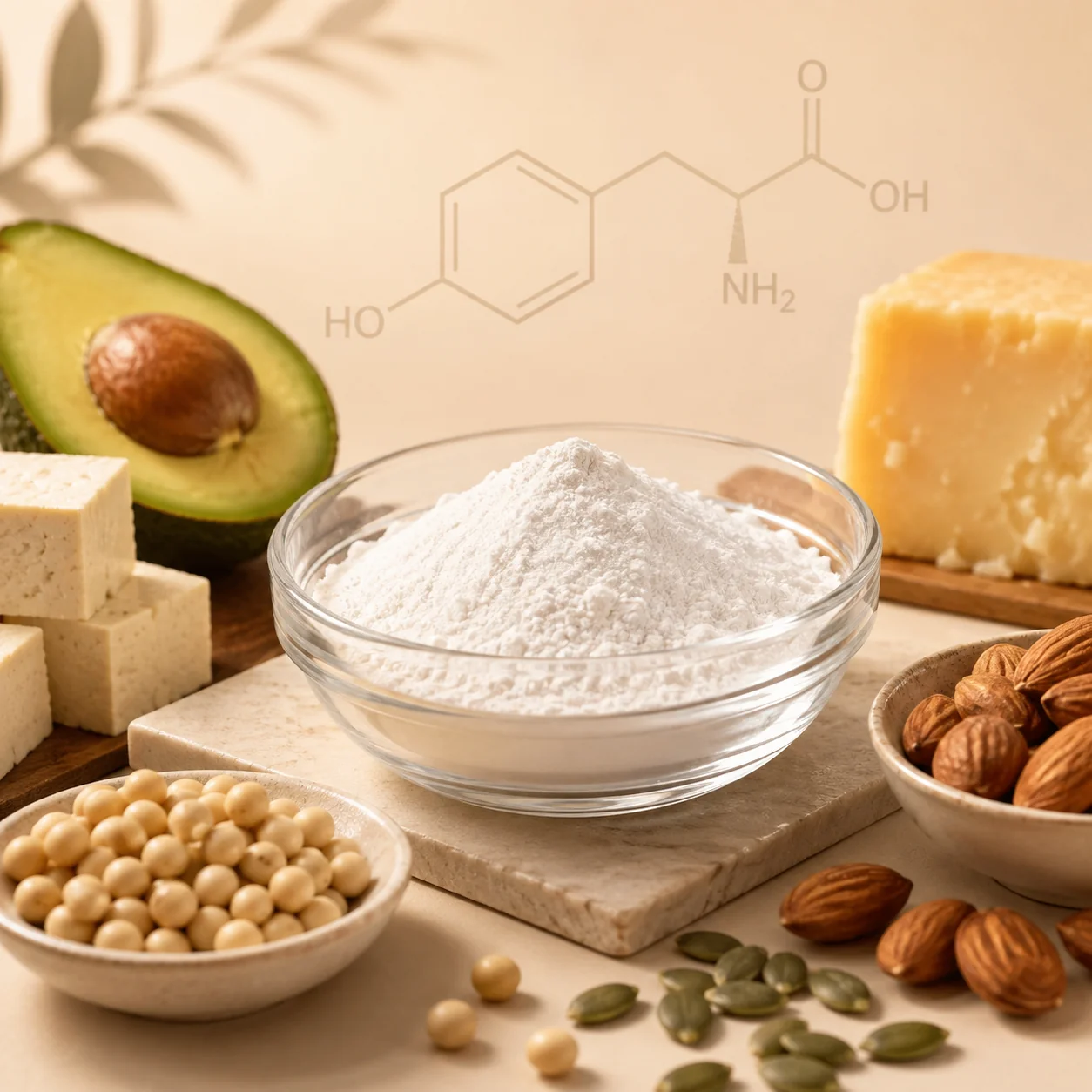
“People are different”
That is the literal title of a 2014 article from a Leiden University research group: “People are different: tyrosine's modulating effect on cognitive control in healthy humans may depend on individual differences related to dopamine function.” The paper argues, from the group's own programme of tyrosine studies, that the amino acid does not act as a uniform cognitive enhancer. Instead its effect depends on where a given person's baseline dopamine system sits, following the kind of inverted-U relationship long established in dopamine pharmacology: too little dopamine impairs certain cognitive functions, too much impairs others, and a substance that nudges dopamine synthesis can move a person in either direction depending on which side of the curve they started on.
Practically, that means the same 2 g of tyrosine that sharpens performance in someone whose dopamine system is taxed by a stressor can do nothing, or even work against a task, for someone whose system was already well within its optimal range before the capsule.
The review that draws the line
A 2015 review by the same group, covering the available cognitive and behavioural studies on tyrosine supplementation, states the conclusion plainly: reports on tyrosine's effectiveness “vary considerably, with some studies finding beneficial effects, whereas others do not.” Its own reading of that inconsistency is that tyrosine's benefit for treating clinical disorders looks limited, and its benefit for physical exercise looks minimal, “perhaps because the link between physical exercise and catecholamine function is mediated by many other factors.” Where the review does see a real, replicated effect is cognitive performance under short-term stressful or cognitively demanding conditions — the cadets' combat course, the cold-hypoxia chamber, the kind of task that taxes working memory over minutes rather than hours.
Its final sentence is the one worth holding onto: tyrosine is an effective enhancer of cognition, but only when neurotransmitter function is intact and dopamine or norepinephrine is temporarily depleted. Read literally, that is a conditional claim with two requirements, not one blanket benefit. A person whose dopamine system has nothing depleted to refill has, by this review's own logic, little reason to expect the effect the cadets experienced.
MindSave on the official website
One capsule a day, thirty to a bottle, eight ingredients named before you buy and every amount printed on the panel that travels with them. Sixty days to send the bottles back, empty ones included.
Order MindSaveWhy a precursor behaves this way
Tyrosine is not a stimulant and it does not act directly on a receptor the way caffeine or a prescription cognitive-enhancer does. It is the dietary precursor amino acid that the body converts into dopamine and norepinephrine, two steps down a synthesis pathway. Supplying more raw material only changes downstream neurotransmitter output if the pathway is running short of that raw material in the first place — which is exactly the condition acute stress is thought to create, by accelerating catecholamine turnover faster than the body can otherwise keep up.
That mechanistic detail explains why the effect is so condition-dependent in a way a simple “supports focus” label claim cannot. A precursor cannot push a system past where its own regulation allows once supply is no longer the bottleneck, and in a system that was never short of raw material to begin with, adding more of it is not expected to do very much at all. That is a materially different mechanism from an ingredient that acts on a receptor regardless of a person's starting state.
| Study | What was tested | Who it helped |
|---|---|---|
| Banderet & Lieberman, 1989 | 100 mg/kg before 4.5 hours of cold and hypoxia | Subjects who showed an average or greater stress response — not everyone exposed to the same cold |
| Deijen et al., 1999 | 2 g/day for five days of a combat training course | Cadets under sustained physical and cognitive demand; a memory task and a tracking task improved |
| Jongkees, Hommel & Colzato, 2014–2015 | A programme of laboratory cognitive-control tasks | People whose baseline dopamine function sat where a modest increase helps rather than overshoots |
Doses and conditions are what each cited paper reports. None of them describes MindSave, which prints no amount for L-tyrosine or any of its other seven names.
Read across the three rows and a pattern holds even though the study designs have almost nothing else in common: a cold chamber in 1989, a military course in 1999, and a laboratory cognitive-control task in the 2010s. In every case, the people who improved were the people whose dopamine or norepinephrine system had something to gain from more raw material, whether because a stressor had drawn it down or because their own baseline sat on the responsive part of the curve. Nothing in any of the three papers claims tyrosine adds cognitive capacity that was not otherwise missing.
What a retracted study does not change
One paper from this same Leiden programme, examining tyrosine alongside brain stimulation, was later retracted by its journal; it is not cited on this page and nothing above relies on it. The two papers cited here — the 2015 review and the 2014 individual-differences article — stand independently of that retraction, and the review's central finding is corroborated by the original 1989 cold-stress trial's own language about who responded and who did not, a paper from a completely different research group four decades earlier. A shared conclusion reached twice, by two unconnected teams working twenty-six years apart, is a more durable basis for the claim on this page than any single study would be.
What this means for an undisclosed dose
Put the two threads together. Tyrosine's cognitive benefit in published research is real but conditional twice over: conditional on the situation being acutely demanding enough to deplete dopamine or norepinephrine, and conditional on the person's own baseline dopamine function being the kind that a modest nudge can actually help rather than push past its optimum. Neither condition is something a supplement label can verify on a shopper's behalf, and MindSave's sales page does not attempt to: it names L-tyrosine among the eight ingredients and, like the other seven, states no amount.
The practical takeaway is closer to a question than a promise. On an ordinary, unstressed day, the research reviewed here gives little reason to expect a noticeable effect from tyrosine specifically, whatever an individual capsule contains. On a genuinely demanding day — the kind the cadets and the cold-chamber subjects were in — the same literature is at its most supportive, though still without ever having tested this particular product. The 30-day routine guide covers how to plan around a serving direction that does not vary by how stressful any given day turns out to be.
What this is and is not. MindSave is a dietary supplement. It is not a medicine and nothing here presents it as a treatment for any diagnosed condition, including anxiety or a stress disorder. The research above describes L-tyrosine as studied in published trials, not this product, which has not been the subject of a published clinical trial and discloses no amount for any of its eight ingredients. Speak to a clinician about a stress or mood concern that worries you.
Sources cited above
- Banderet LE, Lieberman HR. Treatment with tyrosine, a neurotransmitter precursor, reduces environmental stress in humans. Brain Res Bull. 1989;22(4):759-62. PMID 2736402. https://pubmed.ncbi.nlm.nih.gov/2736402/
- Jongkees BJ, Hommel B, Colzato LS. People are different: tyrosine's modulating effect on cognitive control in healthy humans may depend on individual differences related to dopamine function. Front Psychol. 2014;5:1101. PMID 25339925. https://pubmed.ncbi.nlm.nih.gov/25339925/
- Jongkees BJ, Hommel B, Kühn S, Colzato LS. Effect of tyrosine supplementation on clinical and healthy populations under stress or cognitive demands--A review. J Psychiatr Res. 2015;70:50-7. PMID 26424423. https://pubmed.ncbi.nlm.nih.gov/26424423/
- Deijen JB, Wientjes CJ, Vullinghs HF, Cloin PA, Langefeld JJ. Tyrosine improves cognitive performance and reduces blood pressure in cadets after one week of a combat training course. Brain Res Bull. 1999;48(2):203-9. PMID 10230711. https://pubmed.ncbi.nlm.nih.gov/10230711/
Order MindSave on the official website
Eight names published before the sale, every amount printed on the panel that arrives with the bottles, and sixty days to change your mind.
$49 to $79 a bottle · 60 days to change your mind
Order MindSave On The Official WebsiteFree US shipping on six bottles · 60-day money-back guarantee, empty bottles accepted · lot MIN-26/MI-7343